Category: Uncategorized

  • Coroplast, Banner, or Rigid: Choosing the Right Political Sign for Each Job

    Coroplast, Banner, or Rigid: Choosing the Right Political Sign for Each Job

    Campaigns tend to talk about “signs” as if it were one product, then order a single format for every situation and wonder why the banner at headquarters sags after a month or the rally signs disintegrate in a drizzle. A political sign is really a family of formats, each engineered for a different job. Getting the match right is mostly a matter of knowing what each material is actually for, and what it costs you in money and lifespan when you use it in the wrong place. Here is how the common formats sort out, and how to choose among them.

    The four formats a campaign actually orders

    Nearly every political sign order is one of four things. Corrugated plastic yard signs, usually called coroplast, are the flat lawn signs you see by the thousands. Vinyl banners are the large flexible sheets that hang on fences, buildings, and behind podiums. Rigid signs, made of aluminum or aluminum composite, are the heavy, reusable panels built for long-term roadside placement. And foam or poster board signs are the lightweight handheld pieces made for indoor rallies and press events. Each has a natural habitat, and each fails predictably when pushed outside it.

    Read the whole field at a glance

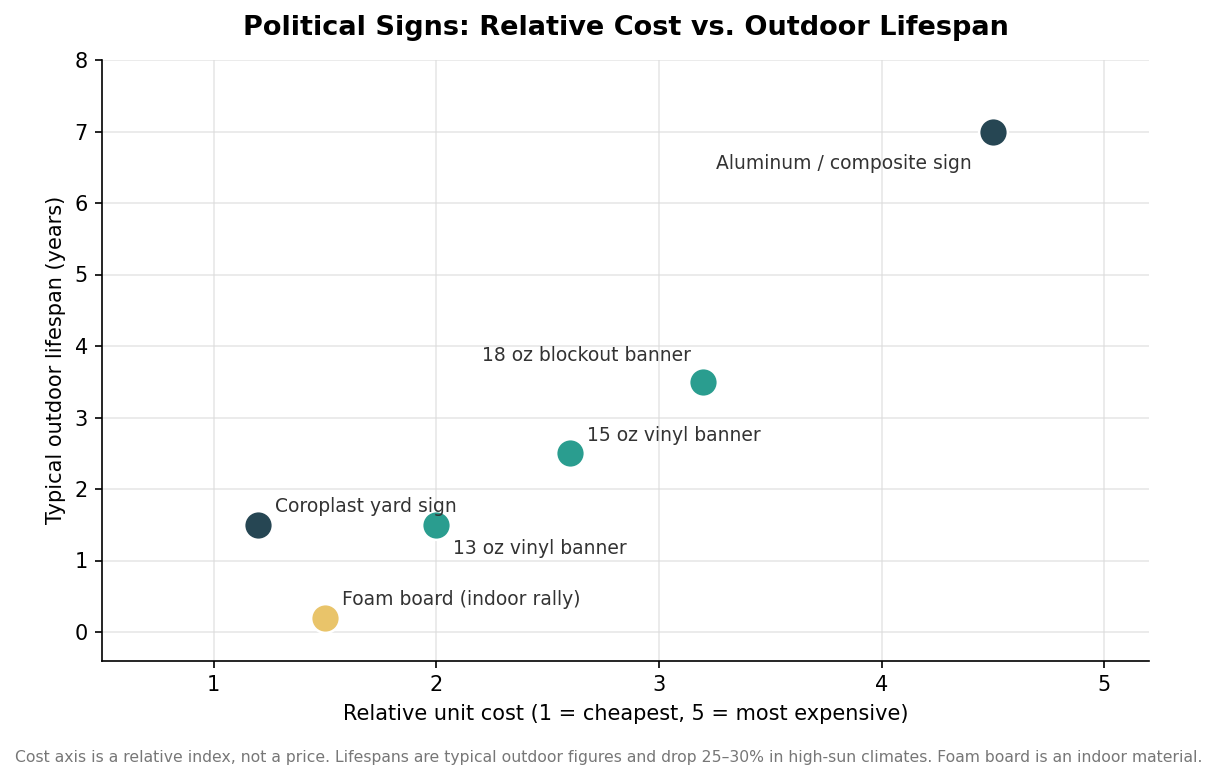
    The trade-off that organizes all four is cost against lifespan. The cheap formats are disposable, the durable formats are expensive, and the useful judgment is deciding how long a given placement actually needs to last. A yard sign that only has to survive one election season does not need the lifespan of an aluminum panel, and paying for that lifespan is wasted money. The chart below maps the common options on relative cost against typical outdoor life.
    Scatter plot mapping political sign formats by relative cost and typical outdoor lifespan in years
    Political sign formats mapped by relative cost against typical outdoor lifespan; cost is a relative index.

    The cluster in the low-cost corner is where most campaign volume lives, and appropriately so. The value of the map is at the edges: it shows why you would never put foam board outdoors, where it lasts weeks at best, and why an aluminum sign only makes sense when it will be reused across multiple cycles or must stand for years. Treat the cost axis as a relative index rather than a price, and remember that every lifespan figure drops by roughly a quarter to a third in a high-sun climate.

    Coroplast yard signs: cheap, disposable, everywhere

    Corrugated plastic in the standard 4mm thickness is the default for a reason. It is completely waterproof, shrugs off heat and cold, prints in full color on one or both sides, and drops onto a wire H-stake in seconds. Rated for one to two years outdoors, it comfortably covers a single campaign season, which is all most yard signs are asked to do. The material’s weakness is not weather but wind and volume: thin coroplast on a light stake will spin, lean, and pull out of soft ground, and at the quantities campaigns buy, losses to theft and weather are simply part of the plan. Coroplast is the right call when you need many signs, cheaply, for a defined stretch of time, and you accept that some will not survive to election day.

    Vinyl banners: when the sign has to hang and hold

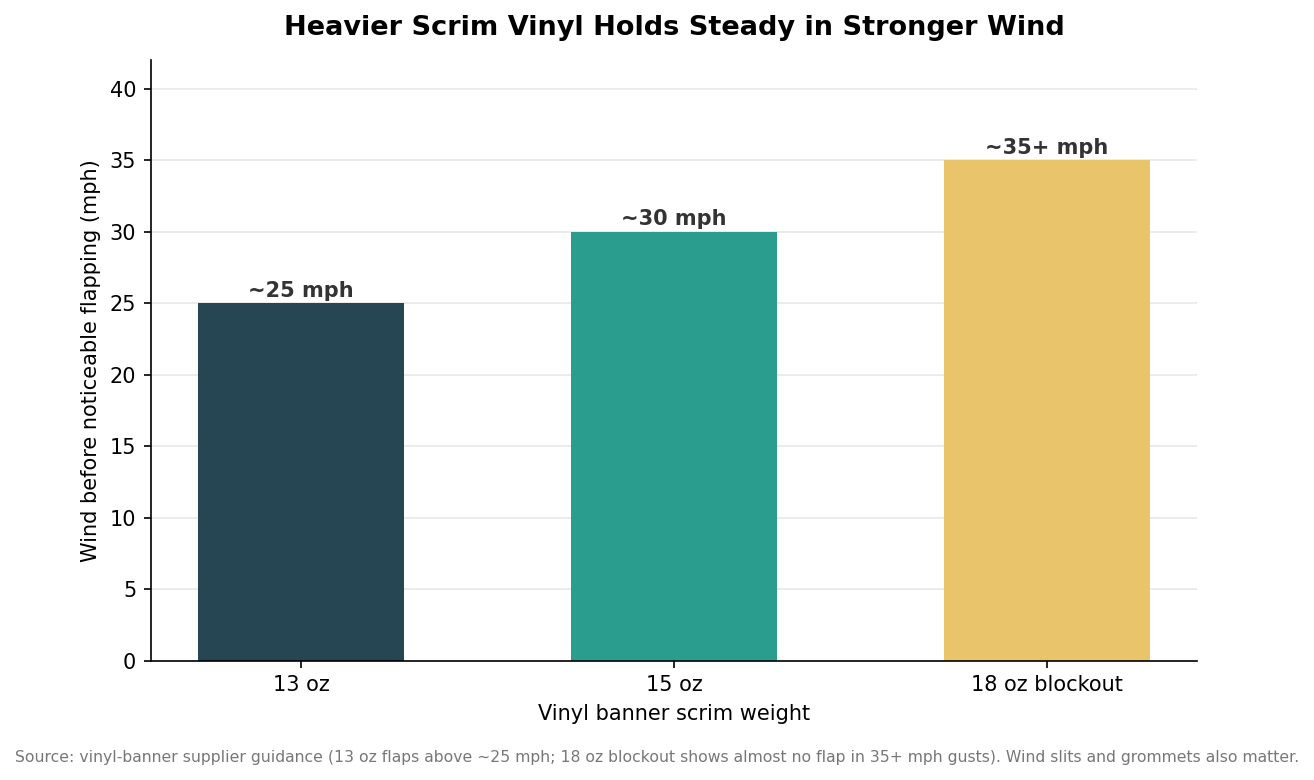
    Banners are the format for a sign that must span a fence, wrap a building, or backdrop a stage, and here the scrim weight is the spec that matters. Thirteen-ounce vinyl, around 440 grams per square meter, is the lightweight, lowest-cost option, good for short indoor runs and outdoor use of a year or two, but it flaps audibly once the wind climbs past about 25 miles per hour. Fifteen-ounce vinyl, near 500 grams, buys two to three years outdoors and noticeably quieter behavior in wind. Eighteen-ounce blockout, about 560 grams, carries a three-year-plus outdoor life, renders bright color on both sides because its inner layer blocks light transmission, and shows almost no flap even in gusts above 35 miles per hour.
    Bar chart of the wind speed at which 13, 15, and 18 ounce vinyl banners begin to flap
    Heavier scrim vinyl resists flapping at higher wind speeds, which extends banner life outdoors.

    The wind behavior is not a cosmetic detail. A banner that flaps hard does not just make noise; it tears at the grommets and shortens its own life. Match the weight to the exposure, hem the edges, set grommets around every two feet, and add wind slits on large outdoor banners so air can pass through. A heavier banner in a windy spot outlasts a lighter one many times over, which usually makes the up-front premium the cheaper choice across a full campaign.

    Rigid signs and foam board: the long haul and the one day

    The two rigid extremes serve opposite needs. Aluminum and aluminum composite panels, typically in the .040-to-.063-inch range for solid aluminum or 3mm to 6mm for composite, resist rust and oxidation and stand for years, which makes them worth the higher cost only when a sign will be reused across cycles or must hold a high-visibility roadside spot for a long stretch. At the other end, foam board and poster board are indoor materials: light, crisp, and perfect for handheld rally signs and press-conference placards, but not weatherproof, so they warp and soften within days if left outside. Expanded PVC sits near foam board here, excellent and long-lived indoors but prone to warping in outdoor heat and sun, so it belongs on the indoor side of the line for most campaign uses.

    The mistake to avoid is using either extreme in the middle ground. Aluminum for a season of lawn signs is money set on fire, and foam board anywhere outdoors is a sign that will not survive its first weather. Each is excellent in its lane and poor everywhere else.

    Match the format to the placement

    Every one of these decisions comes down to two questions: where will the sign stand, and how long does it need to last there. Lawns and rights-of-way for a season point to coroplast. A fence, wall, or stage backdrop points to a vinyl banner, with the weight chosen for the wind and duration. A permanent, reused, or high-value roadside placement justifies rigid aluminum. An indoor rally or a press event calls for foam or poster board. Order each placement its proper format and the whole sign program gets cheaper and more durable at once, because nothing is over-built for a short job or under-built for a hard one.

    Before you place an order, sort your placements into those four buckets and buy to each one. It is a five-minute exercise that prevents the two most common and most expensive sign mistakes: paying for durability you will never use, and watching a cheap sign fail in the weeks that matter most.
  • Where You Can (and Can’t) Legally Place Political Yard Signs

    Where You Can (and Can’t) Legally Place Political Yard Signs

    The most expensive mistake with political yard signs is rarely the printing. It is staking a batch where they get pulled by a road crew, cited by code enforcement, or challenged by a neighbor, and then buying them again. Placement rules vary by state, county, and city, and often by the homeowners association on your own street, so treat what follows as a general map rather than legal advice, and confirm your local ordinance before the first stake goes in.

    The line that governs everything: public versus private

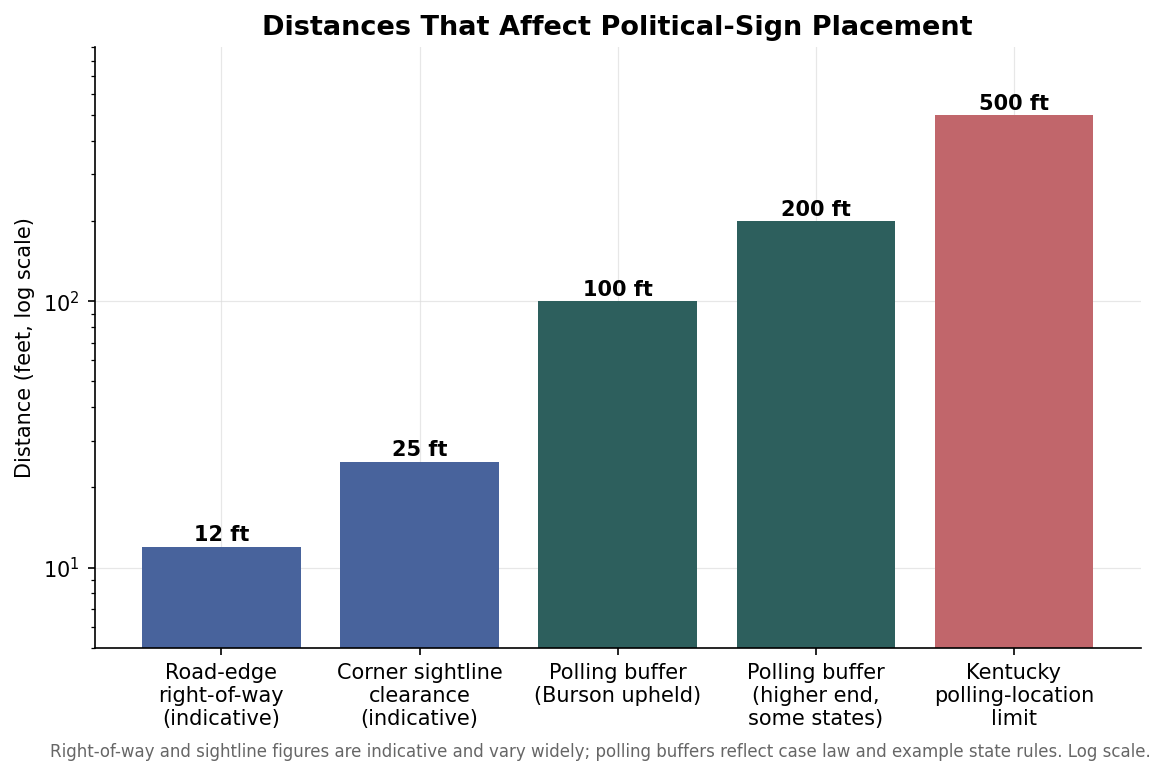
    Private property, with the owner’s permission, is the safest ground you can stand on. The public right-of-way is where most signs disappear: the strip along roads, medians, traffic islands, utility poles, and government property. The catch is that the right-of-way usually extends well past the visible curb, sometimes to the sidewalk or roughly ten to fifteen feet from the pavement, so a sign that looks like it is sitting safely on the grass can still be on public land. When you are not certain where private property ends, keep signs on clearly private lots and off the verge entirely.

    Finding that line does not require a survey crew. The sidewalk is a rough marker, since the strip between it and the street is frequently public, and the utility easement running along the front of most lots is another clue that the ground near the curb is not yours to plant. Your county assessor’s parcel map shows property boundaries, and a quick call to the city’s code enforcement or public works office will usually tell you how far the right-of-way reaches on a given street. Two minutes of checking beats losing a dozen signs to a maintenance crew that is simply clearing what it is required to clear.

    What the Constitution actually protects

    Two Supreme Court decisions shape the ground rules. In City of Ladue v. Gilleo (1994), the Court protected a resident’s right to post a sign at her own home, treating the home as a uniquely important place to speak. In Reed v. Town of Gilbert (2015), the Court held that governments generally cannot single out signs for different treatment based on their message, which means a city cannot write a rule that targets political signs specifically for harsher limits than other temporary signs. What governments can still do is regulate in a content-neutral way: reasonable caps on size, limits on placement for traffic safety, and durational rules that apply across the board. So a town can ban all signs from the right-of-way or cap yard-sign size; it just cannot say that the political ones alone must be smaller.

    Timing: when signs go up and when they must come down

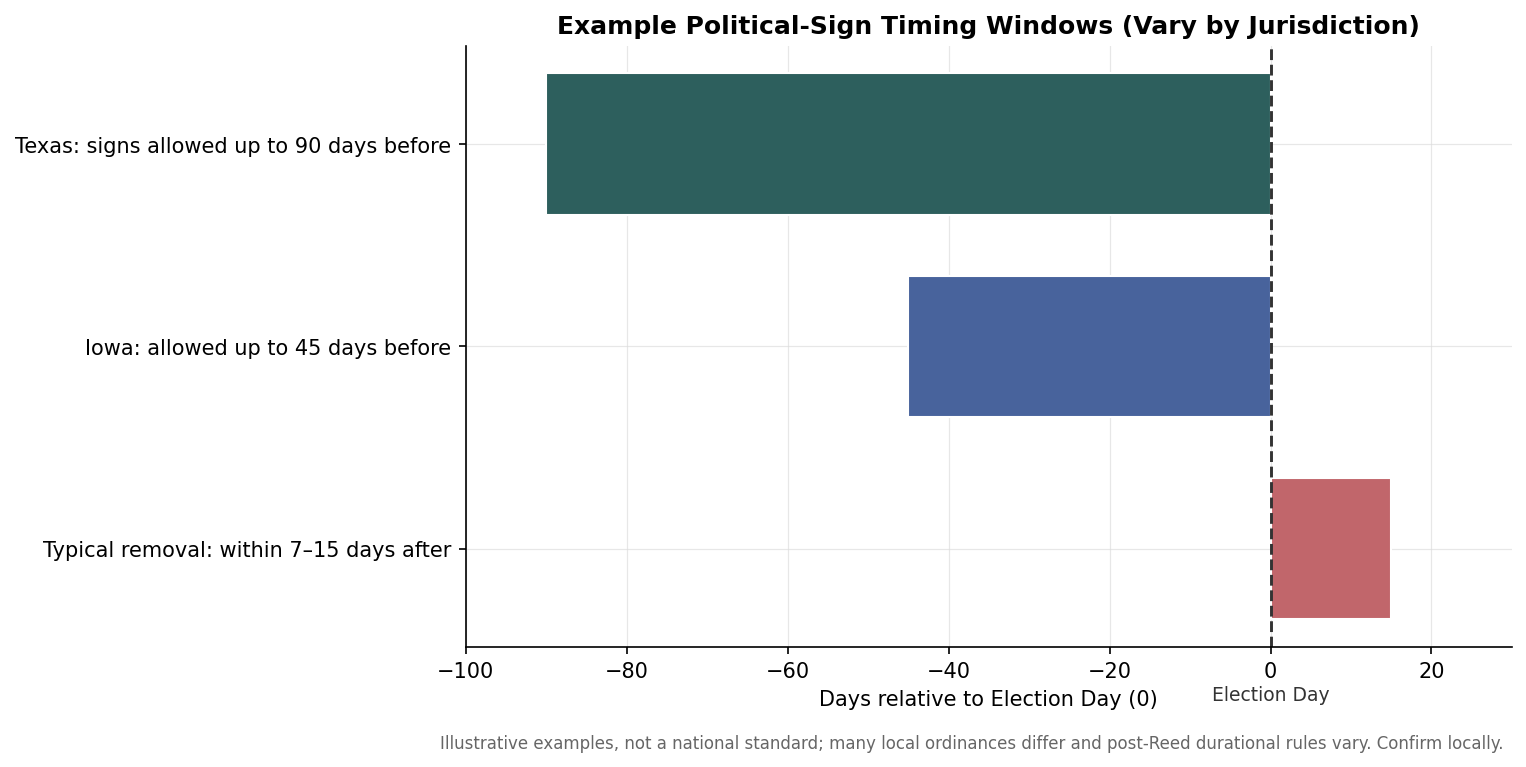
    Historically many jurisdictions set windows, allowing signs to go up a set number of days before an election and requiring removal shortly after. Texas has allowed signs up to ninety days before an election; Iowa has used a forty-five-day window; removal deadlines commonly fall in the seven-to-fifteen-day range after the vote, often around ten days. After Reed, blanket durational limits that apply only to political signs sit on shakier legal footing, but plenty of ordinances remain on the books and removal-after-election rules are widely enforced in practice.

    Timeline chart of example political sign put-up and removal windows relative to Election Day
    Example timing windows relative to Election Day; actual rules vary widely by jurisdiction.

    The practical lesson outlives the legal fine print: do not be the campaign whose signs are still standing a month after the results are in. Leftover signs are the fastest way to irritate neighbors and invite a code complaint, and they cost you goodwill exactly when you are trying to bank it.

    Roads, sightlines, and polling places

    Safety-based placement rules are both the most enforced and the most legally defensible, because they are content-neutral by nature. Signs cannot block a driver’s line of sight at intersections and driveways, cannot be attached to traffic-control devices or utility poles, and cannot sit in medians. A separate set of rules governs the area immediately around polling places on Election Day. In Burson v. Freeman, the Court upheld a hundred-foot campaign-free buffer around polling entrances; states range from roughly one hundred to two hundred feet, and some reach further, with Kentucky restricting signs within five hundred feet of a polling location on Election Day.

    Bar chart on a log scale of distances affecting political sign placement, from right-of-way to polling buffers
    Placement distances span orders of magnitude, from a few feet of setback to polling-place buffers.

    These buffers are about the act of campaigning near voters as they arrive to vote, which is a different question from where a supporter may keep a sign in their front yard the rest of the season.

    HOAs, neighbors, and getting permission

    Homeowners associations are private organizations and can usually set reasonable rules on the size, number, and timing of signs. Some states bar HOAs from banning political signs outright while others allow it, so the governing document to read is your own covenant alongside your state statute. On a neighbor’s lawn the rule is simpler: never place a sign without asking, because the property owner controls what stands on it and can pull an unpermitted sign at will. For a storefront or commercial lot, get the landlord’s consent in writing before you commit a run of signs to that location.

    The reliable playbook is short: private property, the owner’s permission, clear of the right-of-way and driver sightlines, and down within a couple of weeks of the vote. The specific numbers here, the distances, the day counts, the size caps, vary widely from place to place and do change over time, so treat them as typical ranges rather than fixed rules and confirm your city, county, and state requirements, plus any HOA covenant, before you order and place. This is general information to plan around, not legal advice for your specific address.

  • Why Your Yard Signs Spun, Leaned and Blew Away

    A whole run failing in the same way, in the same week, is not a planting problem. It is a manufacturing one.

    How an H-stake actually works

    Corrugated plastic is hollow: parallel flutes run through the whole sheet.

    The two legs of the wire slide up inside two flutes and grip along their length.

    What happens when the flutes run the wrong way

    The legs cannot enter. They press against a closed wall of plastic.

    The sign pivots on the wire, leans within a day, and lifts out in the first gust.

    Why it keeps happening

    A sheet cut the other way yields more signs, so it is cheaper to produce.

    And flute direction is invisible in a PDF proof, so nobody catches it before delivery.

    How to check a sample

    Look at the cut edge: the little tubes should run top to bottom, not side to side.

    Then push a stake in. It should slide, not fight.

  • The Complete Buyer’s Guide to Custom Political Signs

    Political signs are bought on price per unit and judged on how many are still upright a month later. Four decisions connect the two.

    Ask which way the flutes run

    They must run vertically so the stake legs slide up inside them.

    Horizontal flutes yield more signs per sheet and give the wire nothing to grip.

    Ask for the stake by gauge

    Wire gauge and leg length are numbers. Heavy duty is a description.

    Soft ground after rain is the condition that decides it.

    Decide sides by the road

    Two-way roads and corner lots: double-sided, and the second face costs less.

    One-way approaches: single-sided, and buy more signs instead.

    Then cut the copy

    The name, as large as the panel allows. Everything else is negotiable.

    A driver cannot guess at a name they have never seen the way they guess at SALE.

    And leave the year off

    A dated sign is next cycle’s landfill. An undated one runs again.

  • Put Less on the Sign. Then Take Something Else Off.

    Commercial signs get an enormous advantage that political signs never get, and it explains most bad campaign layouts.

    Familiar words are recognised, not read

    SALE, OPEN and FOR RENT are shapes a driver identifies before decoding letters.

    An unfamiliar surname has no shape memory at all: every letter has to be read.

    So the name gets the space

    Bigger than the office. Bigger than feels balanced in a design program.

    High contrast, no thin weights, no script, nothing reversed out of a photograph.

    What comes off first

    The slogan. The website. The year. Usually the party. Often the office.

    Each one steals size from the only word that has to survive the drive-by.

    Check it the way it will be seen

    Print it small, stand back, and read it in the time a car takes to pass.

    If you can only get one thing, the name is the thing.