Campaigns tend to talk about “signs” as if it were one product, then order a single format for every situation and wonder why the banner at headquarters sags after a month or the rally signs disintegrate in a drizzle. A political sign is really a family of formats, each engineered for a different job. Getting the match right is mostly a matter of knowing what each material is actually for, and what it costs you in money and lifespan when you use it in the wrong place. Here is how the common formats sort out, and how to choose among them.
The four formats a campaign actually orders
Nearly every political sign order is one of four things. Corrugated plastic yard signs, usually called coroplast, are the flat lawn signs you see by the thousands. Vinyl banners are the large flexible sheets that hang on fences, buildings, and behind podiums. Rigid signs, made of aluminum or aluminum composite, are the heavy, reusable panels built for long-term roadside placement. And foam or poster board signs are the lightweight handheld pieces made for indoor rallies and press events. Each has a natural habitat, and each fails predictably when pushed outside it.
Read the whole field at a glance
The trade-off that organizes all four is cost against lifespan. The cheap formats are disposable, the durable formats are expensive, and the useful judgment is deciding how long a given placement actually needs to last. A yard sign that only has to survive one election season does not need the lifespan of an aluminum panel, and paying for that lifespan is wasted money. The chart below maps the common options on relative cost against typical outdoor life.
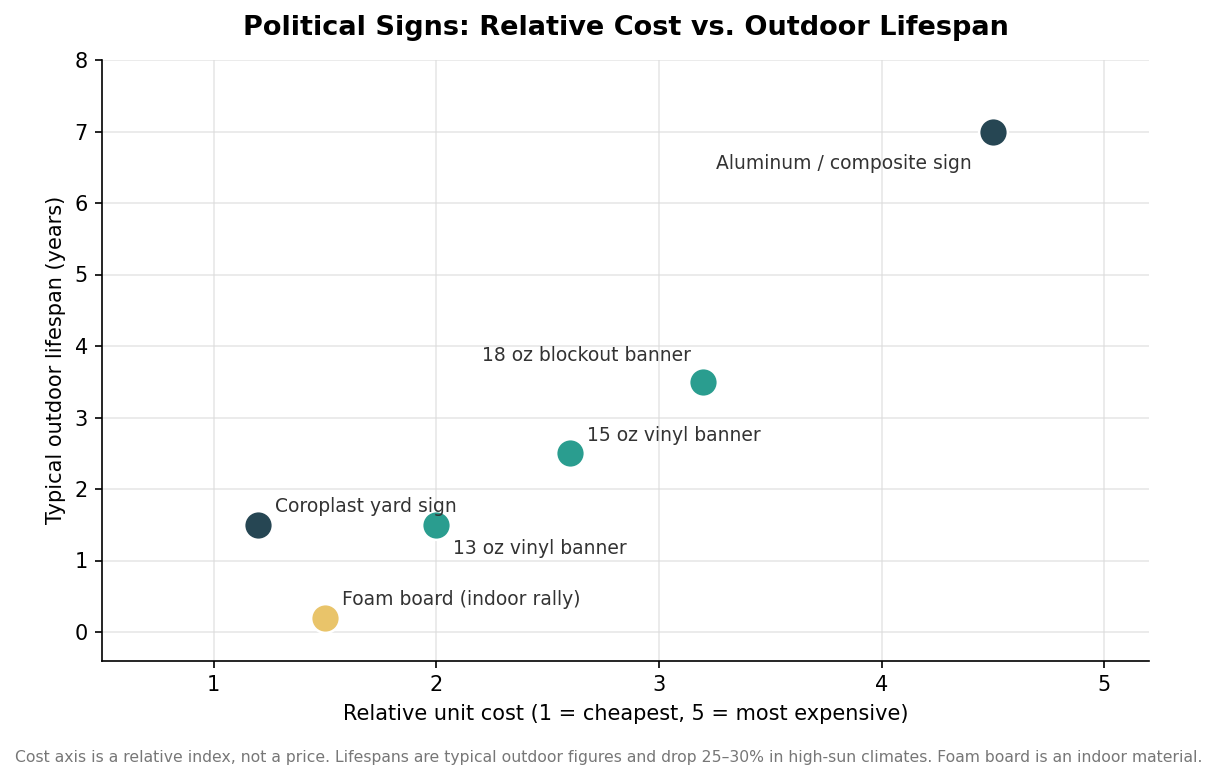
The cluster in the low-cost corner is where most campaign volume lives, and appropriately so. The value of the map is at the edges: it shows why you would never put foam board outdoors, where it lasts weeks at best, and why an aluminum sign only makes sense when it will be reused across multiple cycles or must stand for years. Treat the cost axis as a relative index rather than a price, and remember that every lifespan figure drops by roughly a quarter to a third in a high-sun climate.
Coroplast yard signs: cheap, disposable, everywhere
Corrugated plastic in the standard 4mm thickness is the default for a reason. It is completely waterproof, shrugs off heat and cold, prints in full color on one or both sides, and drops onto a wire H-stake in seconds. Rated for one to two years outdoors, it comfortably covers a single campaign season, which is all most yard signs are asked to do. The material’s weakness is not weather but wind and volume: thin coroplast on a light stake will spin, lean, and pull out of soft ground, and at the quantities campaigns buy, losses to theft and weather are simply part of the plan. Coroplast is the right call when you need many signs, cheaply, for a defined stretch of time, and you accept that some will not survive to election day.
Vinyl banners: when the sign has to hang and hold
Banners are the format for a sign that must span a fence, wrap a building, or backdrop a stage, and here the scrim weight is the spec that matters. Thirteen-ounce vinyl, around 440 grams per square meter, is the lightweight, lowest-cost option, good for short indoor runs and outdoor use of a year or two, but it flaps audibly once the wind climbs past about 25 miles per hour. Fifteen-ounce vinyl, near 500 grams, buys two to three years outdoors and noticeably quieter behavior in wind. Eighteen-ounce blockout, about 560 grams, carries a three-year-plus outdoor life, renders bright color on both sides because its inner layer blocks light transmission, and shows almost no flap even in gusts above 35 miles per hour.
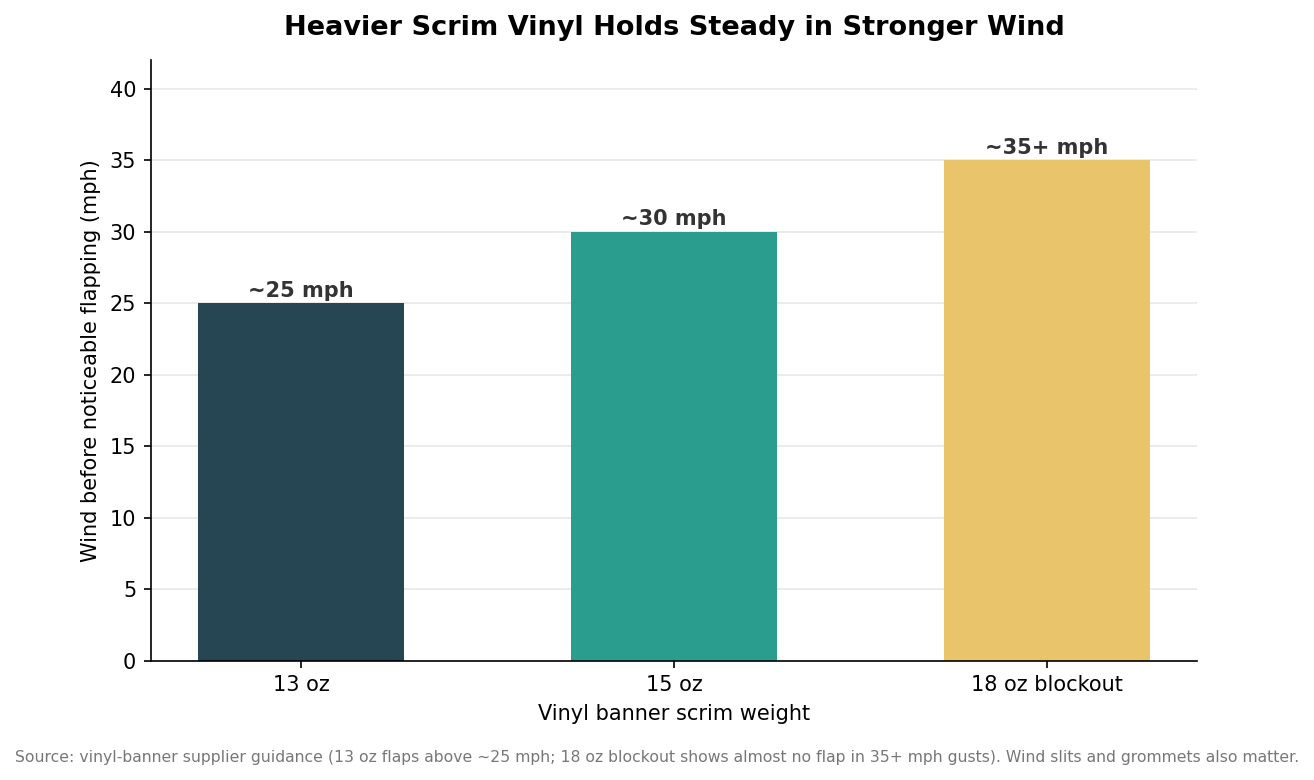
The wind behavior is not a cosmetic detail. A banner that flaps hard does not just make noise; it tears at the grommets and shortens its own life. Match the weight to the exposure, hem the edges, set grommets around every two feet, and add wind slits on large outdoor banners so air can pass through. A heavier banner in a windy spot outlasts a lighter one many times over, which usually makes the up-front premium the cheaper choice across a full campaign.
Rigid signs and foam board: the long haul and the one day
The two rigid extremes serve opposite needs. Aluminum and aluminum composite panels, typically in the .040-to-.063-inch range for solid aluminum or 3mm to 6mm for composite, resist rust and oxidation and stand for years, which makes them worth the higher cost only when a sign will be reused across cycles or must hold a high-visibility roadside spot for a long stretch. At the other end, foam board and poster board are indoor materials: light, crisp, and perfect for handheld rally signs and press-conference placards, but not weatherproof, so they warp and soften within days if left outside. Expanded PVC sits near foam board here, excellent and long-lived indoors but prone to warping in outdoor heat and sun, so it belongs on the indoor side of the line for most campaign uses.
The mistake to avoid is using either extreme in the middle ground. Aluminum for a season of lawn signs is money set on fire, and foam board anywhere outdoors is a sign that will not survive its first weather. Each is excellent in its lane and poor everywhere else.
Match the format to the placement
Every one of these decisions comes down to two questions: where will the sign stand, and how long does it need to last there. Lawns and rights-of-way for a season point to coroplast. A fence, wall, or stage backdrop points to a vinyl banner, with the weight chosen for the wind and duration. A permanent, reused, or high-value roadside placement justifies rigid aluminum. An indoor rally or a press event calls for foam or poster board. Order each placement its proper format and the whole sign program gets cheaper and more durable at once, because nothing is over-built for a short job or under-built for a hard one.
Before you place an order, sort your placements into those four buckets and buy to each one. It is a five-minute exercise that prevents the two most common and most expensive sign mistakes: paying for durability you will never use, and watching a cheap sign fail in the weeks that matter most.