The most expensive mistake with political yard signs is rarely the printing. It is staking a batch where they get pulled by a road crew, cited by code enforcement, or challenged by a neighbor, and then buying them again. Placement rules vary by state, county, and city, and often by the homeowners association on your own street, so treat what follows as a general map rather than legal advice, and confirm your local ordinance before the first stake goes in.
The line that governs everything: public versus private
Private property, with the owner’s permission, is the safest ground you can stand on. The public right-of-way is where most signs disappear: the strip along roads, medians, traffic islands, utility poles, and government property. The catch is that the right-of-way usually extends well past the visible curb, sometimes to the sidewalk or roughly ten to fifteen feet from the pavement, so a sign that looks like it is sitting safely on the grass can still be on public land. When you are not certain where private property ends, keep signs on clearly private lots and off the verge entirely.
Finding that line does not require a survey crew. The sidewalk is a rough marker, since the strip between it and the street is frequently public, and the utility easement running along the front of most lots is another clue that the ground near the curb is not yours to plant. Your county assessor’s parcel map shows property boundaries, and a quick call to the city’s code enforcement or public works office will usually tell you how far the right-of-way reaches on a given street. Two minutes of checking beats losing a dozen signs to a maintenance crew that is simply clearing what it is required to clear.
What the Constitution actually protects
Two Supreme Court decisions shape the ground rules. In City of Ladue v. Gilleo (1994), the Court protected a resident’s right to post a sign at her own home, treating the home as a uniquely important place to speak. In Reed v. Town of Gilbert (2015), the Court held that governments generally cannot single out signs for different treatment based on their message, which means a city cannot write a rule that targets political signs specifically for harsher limits than other temporary signs. What governments can still do is regulate in a content-neutral way: reasonable caps on size, limits on placement for traffic safety, and durational rules that apply across the board. So a town can ban all signs from the right-of-way or cap yard-sign size; it just cannot say that the political ones alone must be smaller.
Timing: when signs go up and when they must come down
Historically many jurisdictions set windows, allowing signs to go up a set number of days before an election and requiring removal shortly after. Texas has allowed signs up to ninety days before an election; Iowa has used a forty-five-day window; removal deadlines commonly fall in the seven-to-fifteen-day range after the vote, often around ten days. After Reed, blanket durational limits that apply only to political signs sit on shakier legal footing, but plenty of ordinances remain on the books and removal-after-election rules are widely enforced in practice.
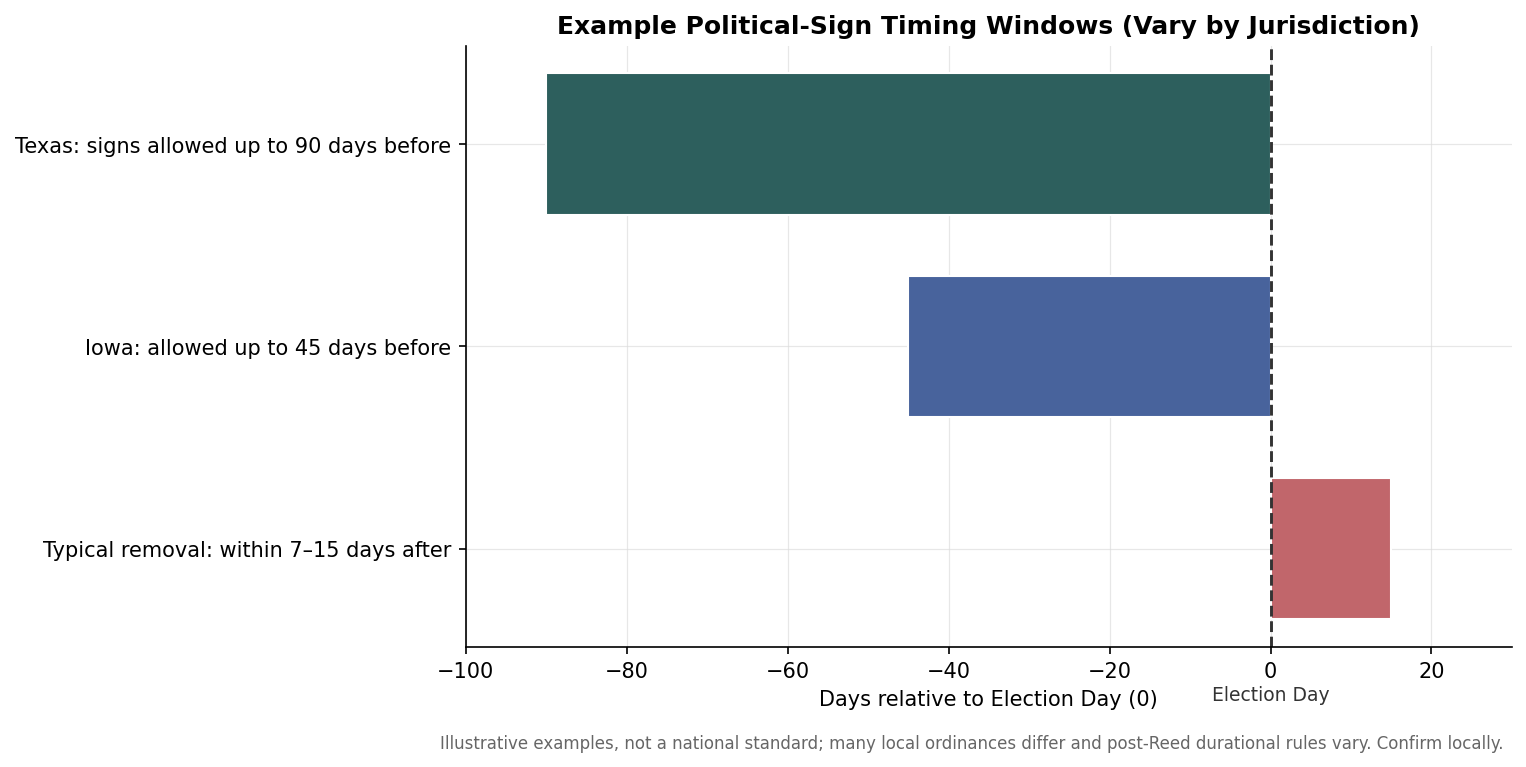
The practical lesson outlives the legal fine print: do not be the campaign whose signs are still standing a month after the results are in. Leftover signs are the fastest way to irritate neighbors and invite a code complaint, and they cost you goodwill exactly when you are trying to bank it.
Roads, sightlines, and polling places
Safety-based placement rules are both the most enforced and the most legally defensible, because they are content-neutral by nature. Signs cannot block a driver’s line of sight at intersections and driveways, cannot be attached to traffic-control devices or utility poles, and cannot sit in medians. A separate set of rules governs the area immediately around polling places on Election Day. In Burson v. Freeman, the Court upheld a hundred-foot campaign-free buffer around polling entrances; states range from roughly one hundred to two hundred feet, and some reach further, with Kentucky restricting signs within five hundred feet of a polling location on Election Day.
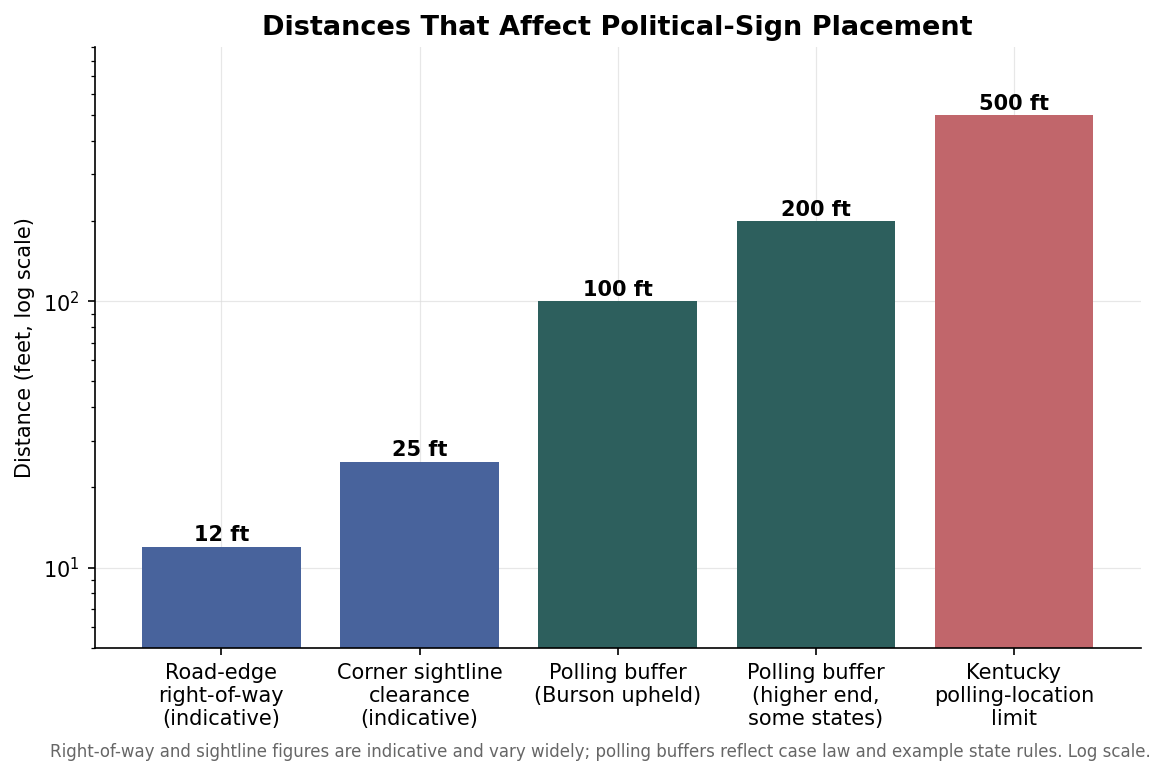
These buffers are about the act of campaigning near voters as they arrive to vote, which is a different question from where a supporter may keep a sign in their front yard the rest of the season.
HOAs, neighbors, and getting permission
Homeowners associations are private organizations and can usually set reasonable rules on the size, number, and timing of signs. Some states bar HOAs from banning political signs outright while others allow it, so the governing document to read is your own covenant alongside your state statute. On a neighbor’s lawn the rule is simpler: never place a sign without asking, because the property owner controls what stands on it and can pull an unpermitted sign at will. For a storefront or commercial lot, get the landlord’s consent in writing before you commit a run of signs to that location.
The reliable playbook is short: private property, the owner’s permission, clear of the right-of-way and driver sightlines, and down within a couple of weeks of the vote. The specific numbers here, the distances, the day counts, the size caps, vary widely from place to place and do change over time, so treat them as typical ranges rather than fixed rules and confirm your city, county, and state requirements, plus any HOA covenant, before you order and place. This is general information to plan around, not legal advice for your specific address.